
Common vs Preferred Stock in Pre-IPO Companies: Which One Are You Buying?
Understand the key differences between common and preferred stock in pre-IPO companies, and what buyers should consider before investing in private shares.

✔ Pre-IPO investing happens before a company goes public and involves higher uncertainty due to limited transparency and liquidity.
✔ Pre-IPO stock value is best tracked using private market signals such as funding rounds, financial performance, leadership quality, and market conditions.
✔ Finding pre-IPO opportunities requires being proactive through research, networking, platforms, and awareness of late-stage company signals.
✔ Buying pre-IPO stock follows a structured private process that includes eligibility checks, due diligence, and longer holding periods.
✔ A disciplined approach and informed guidance can help reduce risk when navigating Pre-IPO investments.
Buying shares before a company goes public has long been associated with insiders and elite investors. Today, access is broader, but risk remains high. The real challenge is not access. It is knowing how to evaluate pre-IPO stock value before making a decision.
Before learning how to value these investments, it helps to answer a common question. What is pre-IPO?
Pre-IPO refers to the stage when a private company raises capital before its initial public offering. At this stage, shares are not traded on public exchanges. Instead, they are sold through private funding rounds to venture capital firms, institutional investors, employees, and sometimes accredited individual investors.
Pre-IPO companies often seek funding to expand operations, enter new markets, or strengthen financials ahead of going public. While the growth potential can be significant, so is the uncertainty.
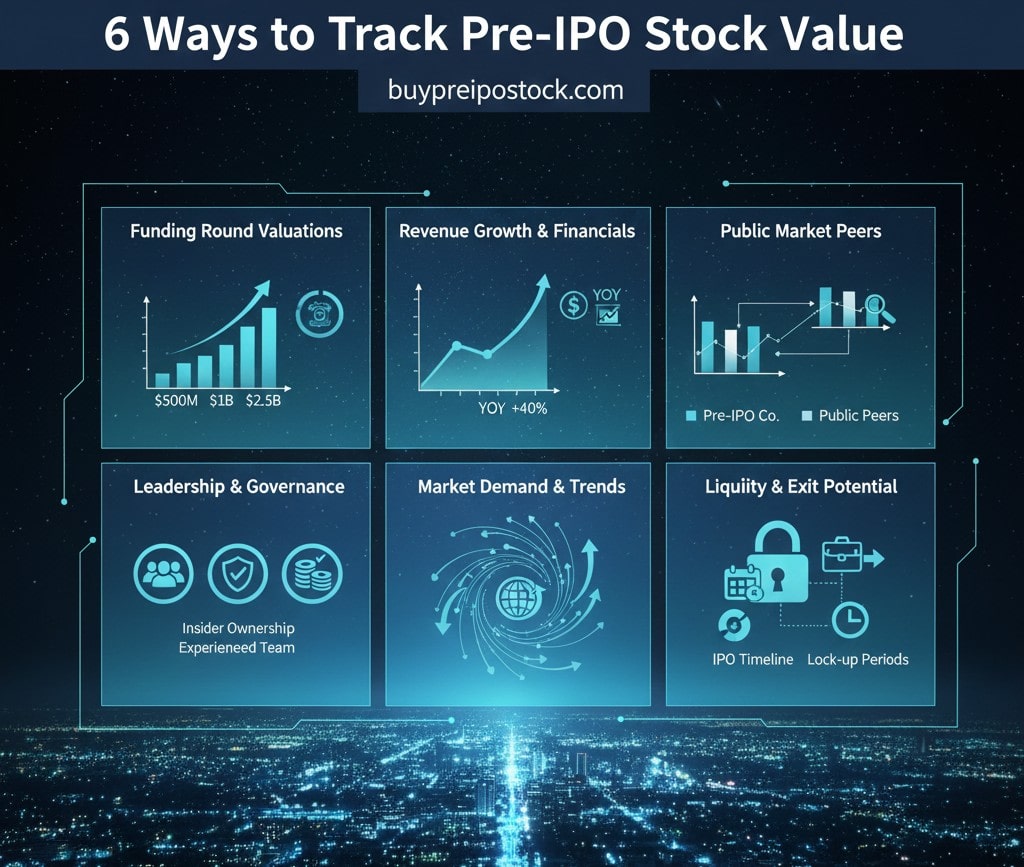
Tracking pre-IPO stock value requires a different approach than public market investing. Since pricing is not visible on an exchange, investors must rely on alternative signals to understand whether a private company is fairly valued.
The most reliable indicator of pre-IPO stock value is the company’s latest funding round. Each round sets a valuation based on what institutional investors are willing to pay. Tracking changes between rounds helps investors identify momentum, stagnation, or potential overvaluation. Consistent valuation growth backed by reputable investors often signals confidence in the company’s future.
Because private companies share far less information, it can be difficult to get a full financial picture. In the U.S., it is rare for a private company to voluntarily release financial reports, even when it is large, and some of the biggest private firms do not publicly disclose results at all.
Even so, revenue signals still matter, so investors should watch for any available clues like year-over-year growth, customer traction, and recurring revenue. Strong growth paired with improving margins can support higher pre-IPO valuations, while growth that comes with weak financial discipline can increase risk.
One effective way to track value is by comparing the company to similar publicly traded businesses. Investors analyze valuation multiples such as price-to-revenue and growth rates within the same industry. This comparison helps determine whether the pre-IPO stock is priced reasonably relative to market standards.
A company’s value often depends on who is running it and how it is managed. It helps to look at the leaders’ track record, how much of the company founders and executives still own, and whether insiders are holding or selling shares. When key people keep a meaningful stake and the company has solid rules and oversight, it can signal long-term confidence. If insiders are selling a lot before the company goes public, it may be a sign to be more cautious.
Pre-IPO stock value is influenced by broader market conditions. Investors should track demand within the company’s sector, competitive positioning, and long-term industry growth. Companies operating in expanding markets with strong tailwinds often justify premium valuations ahead of an IPO.
Tracking value also means understanding liquidity risk. Investors should evaluate expected IPO timelines, acquisition potential, and lockup periods. Limited liquidity often requires a valuation discount, while clearer exit paths can support higher pricing when investors buy pre-IPO stock.
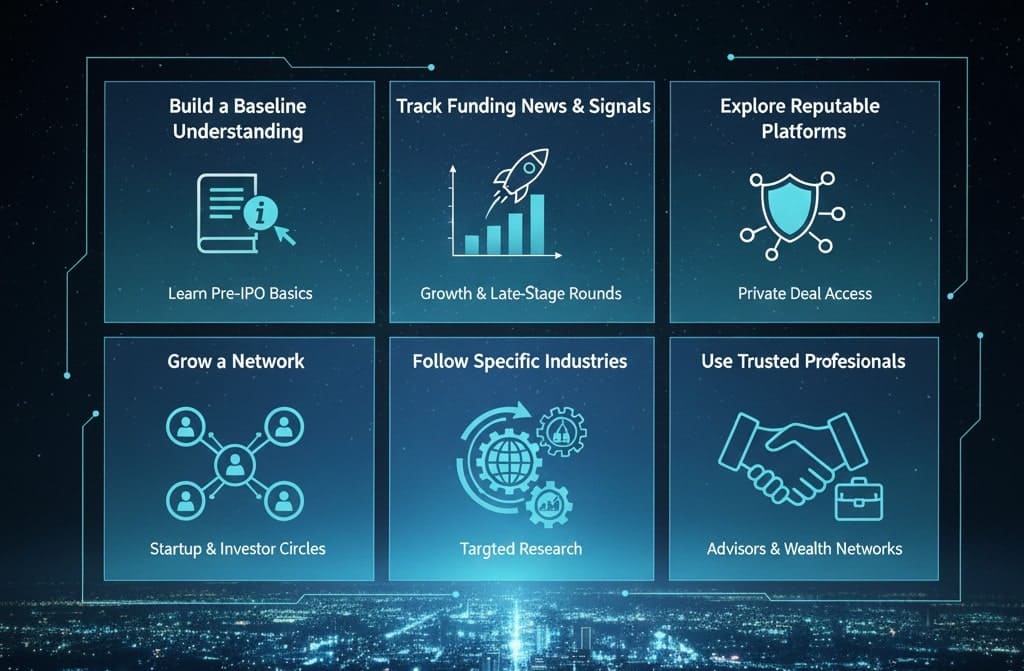
People looking to learn how to buy pre-IPO stock usually need to be proactive. Pre-IPO opportunities are far less visible than public stocks, so the process often centers on building access, staying informed, and recognizing signals that pre-IPO companies may be approaching a funding round or preparing for a future IPO.
Before searching for deals, people should understand what pre-IPO stock is pre-IPO and why pre-IPO stock is priced and sold differently than public shares. Knowing the basics makes it easier to spot legitimate opportunities and avoid confusing hype with real traction.
A practical way to find pre-IPO companies is to follow funding announcements, late-stage venture rounds, and industry coverage. Companies raising large rounds, expanding quickly, or hiring heavily for finance and compliance roles can be closer to offering pre-IPO stock access.
People often find opportunities through platforms that list private deals. These can help investors learn how to buy pre-IPO stock in a structured way, while also showing typical deal terms and how pricing is presented in the private market.
Many pre-IPO opportunities spread through relationships first. People can meet founders, operators, and investors through professional communities, events, and online groups. A strong network increases the chance of hearing about pre-IPO deals earlier.
It helps to pick a few sectors and track them consistently. When people understand an industry, they are better at spotting which pre-IPO companies have durable demand, real differentiation, and momentum that could support long-term value.
Some investors find pre-IPO opportunities through advisors, private banks, or wealth networks. These channels can also help evaluate fit and risk, especially for people still learning how pre-IPO investing works.

The process of purchasing pre-IPO shares is different from buying public stocks. There is no open exchange or instant execution. Instead, investors move through a series of steps designed to confirm eligibility, evaluate the company, and complete a private transaction.
Most pre-IPO deals are limited to accredited investors, so income or net worth usually must be verified first. This determines whether participation is legally allowed.
After eligibility is confirmed, investors look for pre-IPO companies through private platforms, networks, or secondary markets. Shares may come directly from the company or from existing holders like employees.
Pre-IPO stock comes with offering documents that outline valuation, share type, restrictions, and dilution risk. Reviewing these details helps clarify what is actually being purchased.
Investors research the company beyond the pitch materials, including its business model, leadership, financial health, and market position. This helps judge whether the pricing makes sense.
Once terms are accepted, funds are committed, and paperwork is completed, often through escrow and subscription agreements. The process can take time and is not instant like public trading.
Pre-IPO shares are usually not easy to sell right away. Investors typically hold until an IPO, acquisition, or an approved secondary sale becomes available.
Yes. Pre-IPO stock has less transparency and no guaranteed timeline to sell. The company may never go public, and valuations can shift quickly. Investors should expect higher uncertainty than public stocks.
Usually not. Most pre-IPO deals are limited to accredited investors due to regulations. Some people may get indirect exposure through certain structures, depending on what is offered. Eligibility should be confirmed before trying to buy pre-IPO stock.
Pricing is typically based on private funding rounds or negotiated secondary sales. It reflects demand, company performance, and deal terms rather than daily trading. That is why prices can vary across transactions. Research matters more in private markets.
There is no standard timeline. Some pre-IPO companies go public within a few years, while others stay private much longer. Market conditions and strategy play a big role. Investors should avoid assuming a quick exit.
Not usually. Pre-IPO stock is often illiquid and tied to uncertain exit timing. Short-term gains are hard to realize without an IPO or acquisition. It fits better as a longer-term play.
Navigating pre-IPO investments takes more than access. It requires understanding valuation, timing, liquidity, and risk within private markets. Buy Pre-IPO Stock by Best connects individuals with experienced advisors who can help assess pre-IPO companies, review opportunities, and provide guidance throughout the decision process.
Connect with an advisor through Buy Pre-IPO Stock by Best to take the next step.
DISCLAIMER:
This content is for informational purposes only and does not constitute investment, legal, or financial advice. Pre-IPO investing involves risk, including limited liquidity and uncertainty around outcomes. Investors should conduct independent research and consult qualified professionals before making any investment decisions.
Understand the key differences between common and preferred stock in pre-IPO companies, and what buyers should consider before investing in private shares.

Understand the differences between SPV pre IPO investments and direct shares, including ownership, rights, fees, and liquidity considerations before investing.

Non-accredited investors generally cannot buy SpaceX stock before its IPO due to legal and private offering restrictions. This guide explores realistic options and risks.